Published: 01/09/2026
By Catherine Wu, Global Health Communications Assistant
From Central California to Guatemala to Kenya, resources developed by students in the 2025-2026 Science Writing Advancing Global and Planetary Health (SWAP) program aim to improve health communication worldwide.
A collaboration between the Stanford Center for Innovation in Global Health, Stanford Center for Human & Planetary Health, Notation in Science Communication, and Master’s in Environmental Communication, SWAP is a multi-quarter program pairing Stanford students with global and planetary health scientists and science communicators. Students are paired with researchers who have findings they wish to translate to communities impacted by the research. Students work with the mentors and community stakeholders to develop a portfolio of strategic communications resources.
The course is taught by Dr. Desiree LaBeaud, MD, associate dean of global health, Jamie Hansen, communications manager at the Stanford Center for Innovation in Global Health, and Sara Damore, planetary health program manager at the Stanford Center for Human and Planetary Health. Rani Chor, a senior studying international relations, is the course’s Community Engaged Learning Coordinator.
On December 8, this year’s SWAP cohort presented their progress to date during a mid-year showcase to Stanford faculty, community partners, and journalism and communications experts.
The showcase opened with a presentation from Madeleine Bair, award-winning journalist, media developer, alumna of Stanford’s John S. Knight Fellowship Program, and founder of El Tímpano, a local journalism outlet empowering Latino and Mayan immigrant communities in Oakland.
“As you design communication strategies to reach impacted communities on environmental or health issues, remember that communication is a two-way street,” Bair said. “It involves providing information and creating pathways to be heard.”
With SWAP designated a Cardinal Course by the Haas Center for Public Service, Bair’s themes echo the Haas Center’s Principles of Ethical and Effective Service, including humility, respect, and inclusion as students work with community partners to develop tailored communications products.
This year’s SWAP cohort included Edward Apraku, Chloe Chan, Casey Greene, Tim Jing, Jamie JudahBram, Julieta Lamm-Perez, Gavin Nalu, Meerashree Sundara Raju, Sophia Sanders, Sou Min Shin, and Jayson Toweh. Students’ presentations also echoed similar themes in their community-driven approaches. In particular, using a Theory of Change model, each student presented their progress update, community engagement, and areas for feedback.
Students conducted research to generate informational resources for local communities, from Guatemala to Sub-Saharan Africa.
Julieta Lamm-Pérez, a junior studying human biology, researched “Dengue Fever Dynamics & Community Education in Guatemala” with Dr. Erin Mordecai, PhD, associate professor of biology, and Talya Shragai, research and program manager with the Disease Ecology in a Changing World program based at the Stanford Center for Human and Planetary Health.
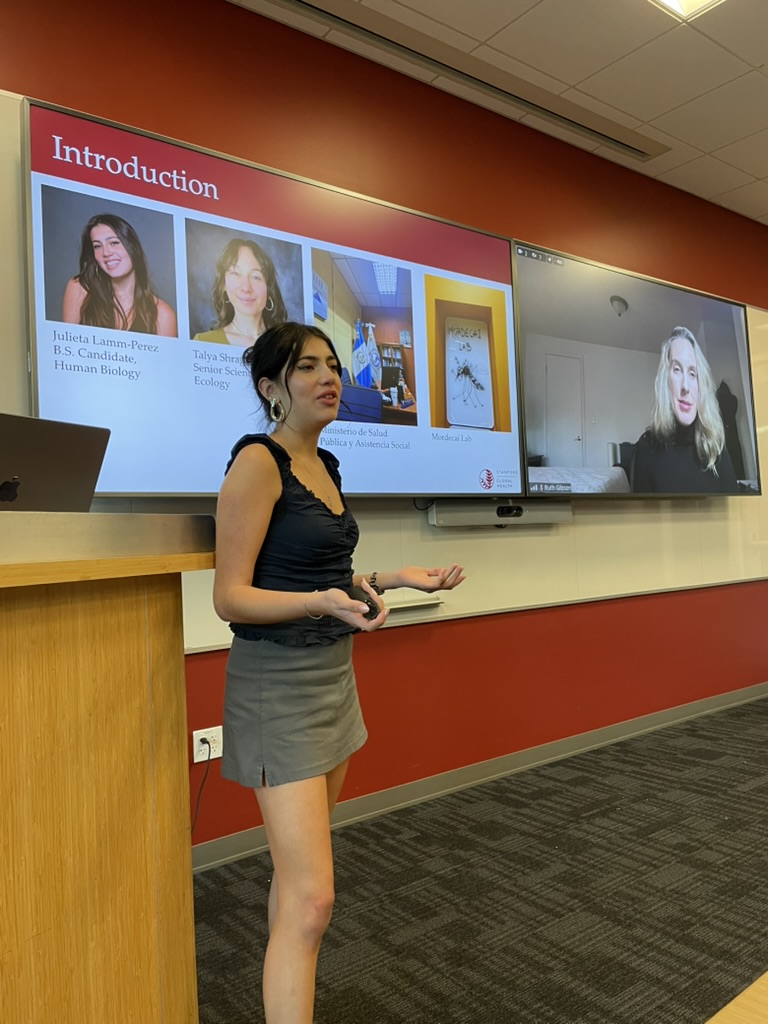
When a relative of Lamm-Perez’s passed away from dengue in Guatemala very suddenly, “It made me realize that I didn’t realize that dengue was such a big deal in Central America still,” she said. This loss motivated her to delve deeper into research about the growing public health crisis.
Later, upon visiting Guatemala for vacation, she went to the ministry of public health: “I knocked on their door, and then I got turned away, and then I didn’t leave, and I went and knocked on some more doors until I finally was able to get an hour and a half long discussion with the Director of the Ministry of Health,” Lamm-Perez said. She shared her findings from her time working in Mordecai Lab, researching malaria in Costa Rica. Lamm-Perez and the director discussed disease dynamics and the difficulty in funding programs at the village and community levels, she said. In the Mordecai Lab, Lamm-Perez continued to statistically analyze the Ministry’s vector control methods, cross referenced with environmental drivers. Though with her work she felt there was a gap between the knowledge understood by the scientific community and the Guatemalan community.
This led Lamm-Perez to her SWAP project, which seeks to translate the Mordecai Lab’s findings about key factors underlying the transmission and outbreaks of dengue in Guatemala into accessible, community-centered prevention strategies, in partnership with Guatemalan communities. Lamm-Perez plans to develop short, animated, non-verbal videos that can communicate key ideas while transcending language and cultural barriers.
Casey Greene, a sophomore studying biology and Spanish, became drawn to science communication and storytelling while working at a news organization over the summer.
“I wanted to get better with my science communication tools and to develop those, and SWAP seemed like the crucial next step,” she said.
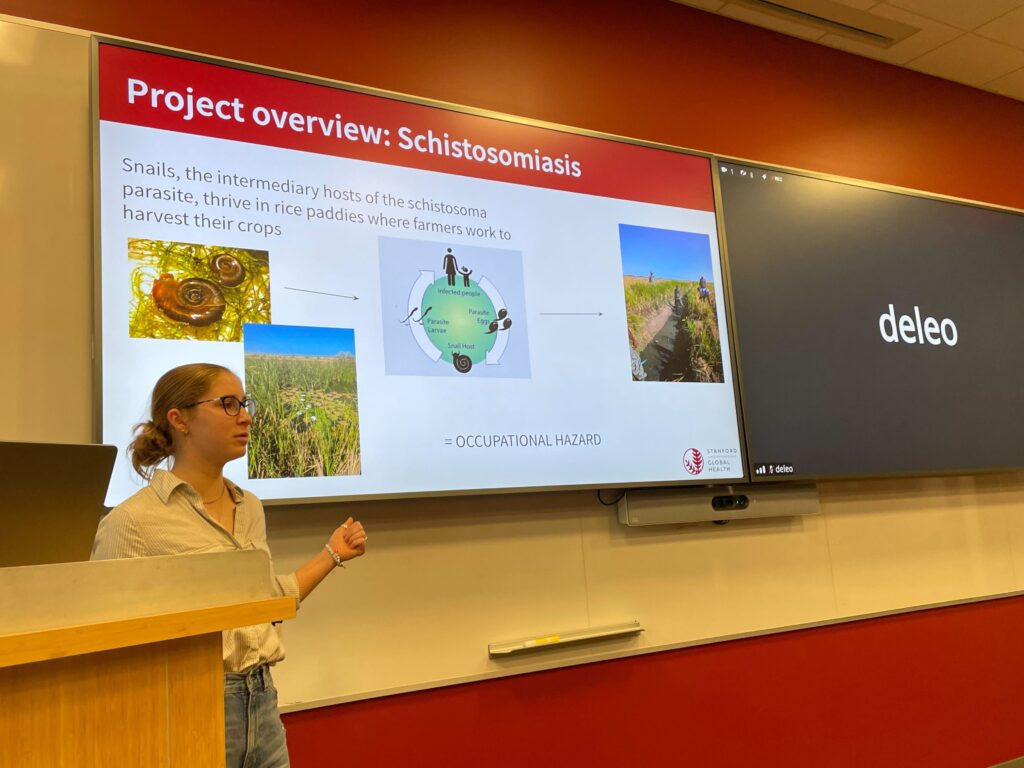
Greene is working with Dr. Giulio De Leo, PhD, a professor of oceans, earth system science, and biology, to share a novel solution to a serious parasitic disease with farmers in Sub-Saharan Africa. Schistosomiasis is a parasitic disease spread to humans through contaminated freshwater. Rice farmers are highly vulnerable to infection because the farms provide an ideal habitat for the snails that house the parasitic flatworms. Greene is helping Dr. De Leo to promote a biological solution — introducing the snail vectors’ natural predators, fish into rice paddies. They are developing a series of fact sheets to help increase awareness and interest in integrating fish aquaculture into irrigated agriculture, a win-win solution which addresses health risks while generating added income for the farmers.
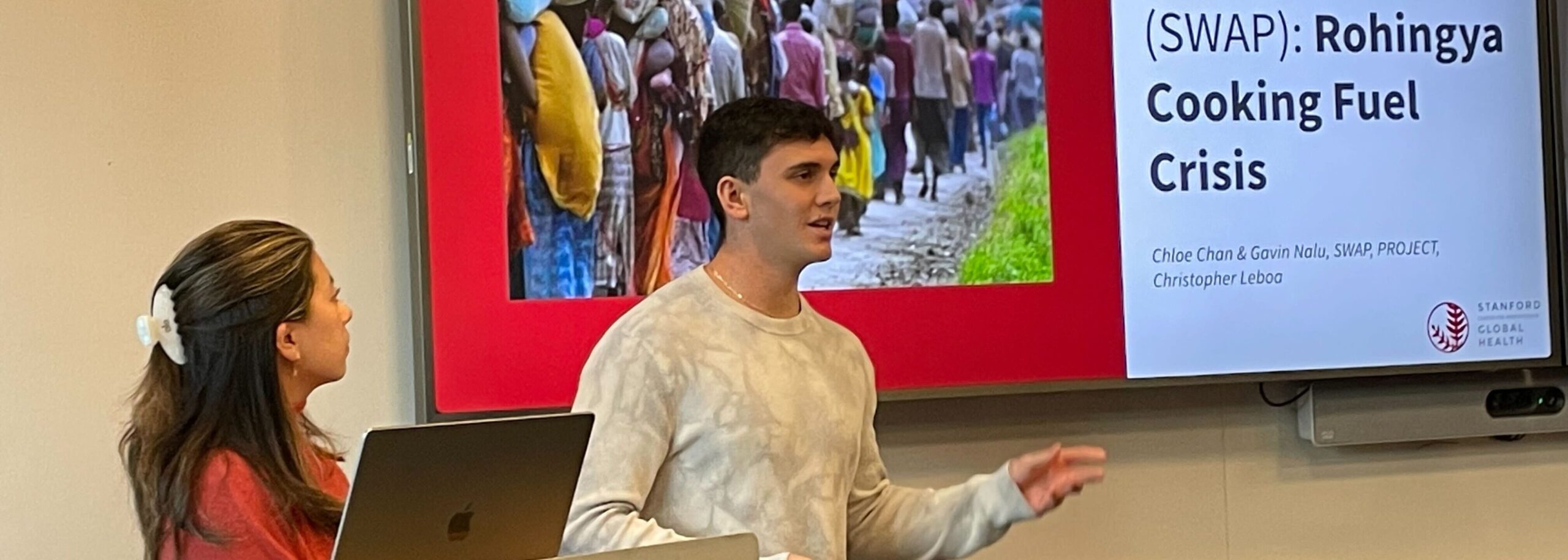
Chloe Chan, a junior studying Human Biology, and Gavin Nalu, a Master’s Student in Environmental Communication, collaborated with Christopher LeBoa, a postdoctoral scholar and fellow in the National Institute of Health Global Health Emerging Scholars program, to help raise awareness of the health and environmental challenges of a cooking fuel crisis faced by Rohingya refugees in Myanmar. LeBoa has been working with partners in the Rohingya refugee community for years to increase public awareness of the environmental and humanitarian crisis caused when refugees living in camps do not have access to cooking fuel. A lack of cooking fuel contributes to hunger, while leading to deforestation as trees are cut for fuel.
“The ability for public awareness to alter humanitarian aid globally for a crisis like a genocide is very powerful to bring change in a way that aligns with what the research clearly indicates should happen,” Nalu said. Through their project, Chan and Nalu hope to re-energize public interest in humanitarian support for the Rohingya humanitarian crisis through op-eds and multi-media storytelling that highlight the voices of Rohingya youth living in the camps..
Tim Jing, a senior studying biomedical computation, is using video storytelling to raise awareness about how conflict affects the provision of healthcare in Africa, in collaboration with Dr. Ruth Gibson, PhD, a visiting scholar with the Stanford Center for Innovation Global Health.
This project combines Jing’s interests in AI, policy, and global health through science communication. “I believe AI and healthcare are two of the most obscure black boxes that exist today,” he said. “It’s extremely important that we increase trust in our institutions in today’s time through effective communication, and that is what I hope to achieve and learn about through the SWAP program.”
Jing and Gibson are conducting a series of in-depth interviews with African health leaders to gain a better understanding of ongoing conflicts and their impacts on healthcare systems in the affected countries. From these interviews, Jing is producing short- and long-form videos that will be shared across social media platforms in order to raise awareness and visibility for these challenges while elevating the voices of health leaders in Africa.
These are just four of the ten global and planetary health communication projects students are undertaking through SWAP. Each student spent the autumn quarter engaging with their research mentor’s findings, understanding the needs of impacted communities, and gaining an understanding of science communication skills and best practices through readings, guest lectures, and course discussions.
During the winter quarter, students will complete their communication products and refine them with input from their research mentors and community stakeholders.